

Most workplace friction isn't caused by people refusing to do their jobs. It's caused by people not knowing exactly where their job ends and someone else's begins. Two people handle the same customer. A task falls between two teams. A manager assumes something was done because "it's obviously part of your role".
Clearly defined roles and responsibilities prevent this. Here's how to write them so they actually get used.
Role vs responsibility
- Role: the position someone holds and the purpose it serves - "Customer Success Manager: keeps customers successful and renewing".
- Responsibilities: the specific outcomes and ongoing duties that role owns - "Runs onboarding calls for new accounts", "Owns renewal rate for assigned accounts".
A title alone tells people very little. Two companies can have a "Operations Manager" doing completely different jobs.
What a good role definition includes
For each role, document:
- Role purpose - one sentence on why the role exists.
- Reports to - the role's manager.
- Key responsibilities - 5 to 10 outcomes or duties, grouped into areas.
- Decision rights - what the role can decide alone, and what needs approval.
- KPIs - how success is measured.
- Key relationships - who they work with most, inside and outside the company.
- Skills and qualifications - what's needed to do the role well.
- Related SOPs - the documented processes the role performs.
Our roles and responsibilities library has ready-made examples of this structure for over 30 common job titles.
Step 1: Start from outcomes, not tasks
A long list of tasks ("answer emails", "attend meetings", "update spreadsheet") describes activity, not responsibility. Start by asking: what should be true because this role exists?
For a customer support lead, that might be:
- Customers get a helpful response within the target time.
- Complaints are resolved in line with policy.
- Recurring problems are identified and fixed at source.
- The support team is trained and performing.
Then list the key duties that deliver each outcome.
Step 2: Write responsibilities with action verbs
Start each responsibility with a strong verb and make it specific:
Step 3: Define decision rights
This is the part most role descriptions leave out - and the main reason people escalate everything. For each role, list:
- Decides alone: e.g. "Approves refunds up to 5,000"
- Decides after consulting: e.g. "Changes the support rota after checking with the operations manager"
- Recommends, someone else decides: e.g. "Proposes new hires; the manager approves"
Clear decision rights are what make delegation actually work.
Step 4: Check for gaps and overlaps
Once you've drafted responsibilities for every role in a team, put them side by side:
- List the team's key activities and outcomes in rows.
- Mark which role owns each one.
- Look for rows with no owner (gaps) and rows with two owners (overlaps).
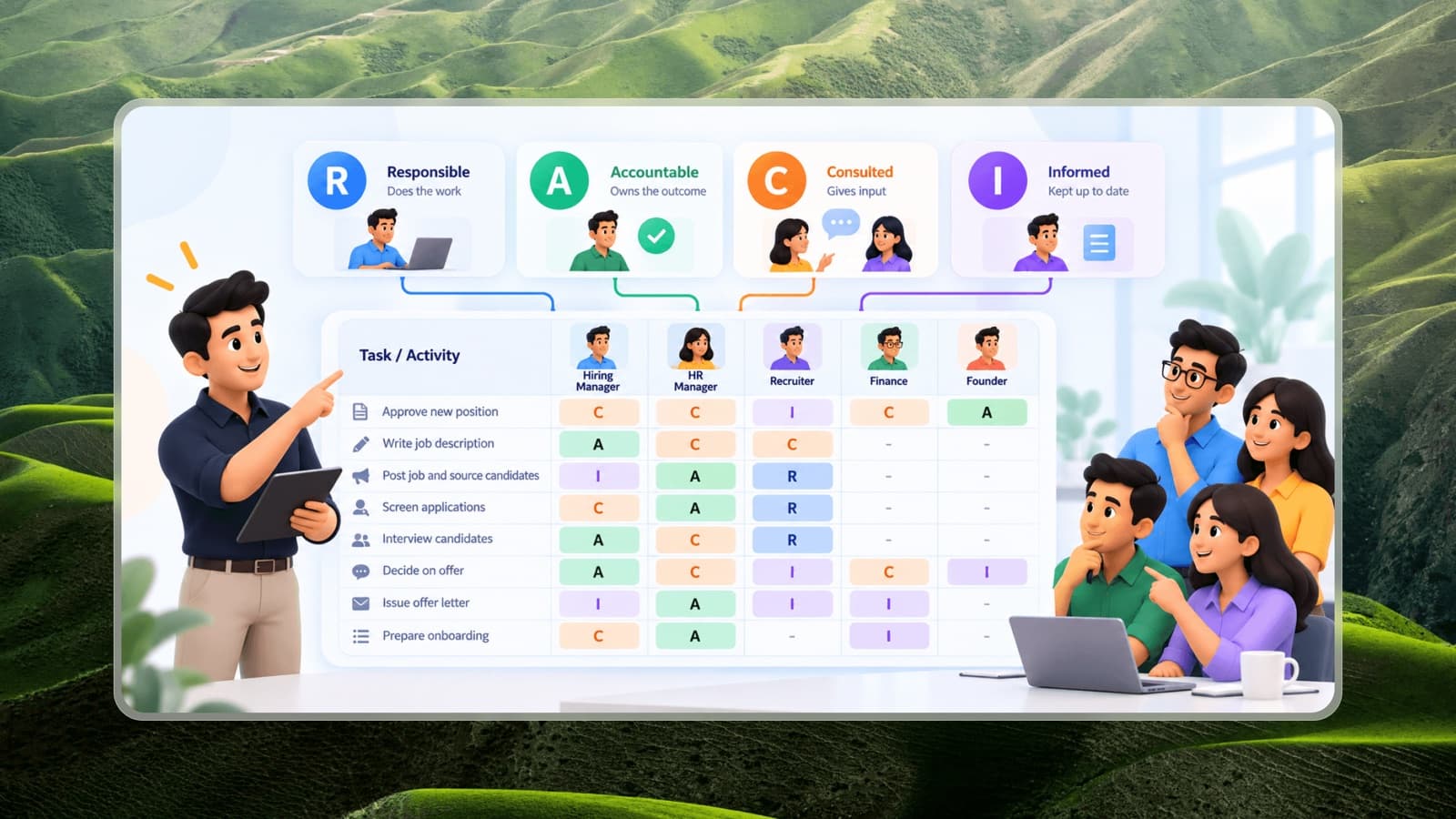
For processes that pass between several teams, a RACI matrix makes this analysis much easier.
Step 5: Review with the people in the roles
Share drafts with each person and their manager. Ask:
- Does this match what you actually do?
- Is anything you do missing?
- Is anything listed that someone else really owns?
- Which decisions do you have to escalate that you could make yourself?
Expect a few surprises. That's the point.
Step 6: Connect roles to the org chart and SOPs
Roles become far more useful when they're connected to the rest of your company system:
- Link each box on the org chart to its role definition.
- Link each responsibility to the SOPs that explain how to do it.
- Use role definitions in job descriptions, onboarding plans and performance reviews.
Roles and responsibilities template
Copy this structure for every role:
Role title:
Department / Reports to:
Role purpose: One sentence on why this role exists.
Key responsibilities:
- Area 1 - 2-3 responsibilities
- Area 2 - 2-3 responsibilities
- Area 3 - 2-3 responsibilities
Decision rights: Decides alone / after consulting / recommends only
KPIs: 3-5 measures of success
Works closely with: Roles and external partners
Skills and qualifications: Must-have and nice-to-have
Related SOPs: Links
Keep roles alive
Role definitions go stale as companies grow. Review them when someone joins or leaves a role, when a team is restructured, and at least once a year during performance reviews. A role description that matches reality is one of the most useful documents a growing company can have.