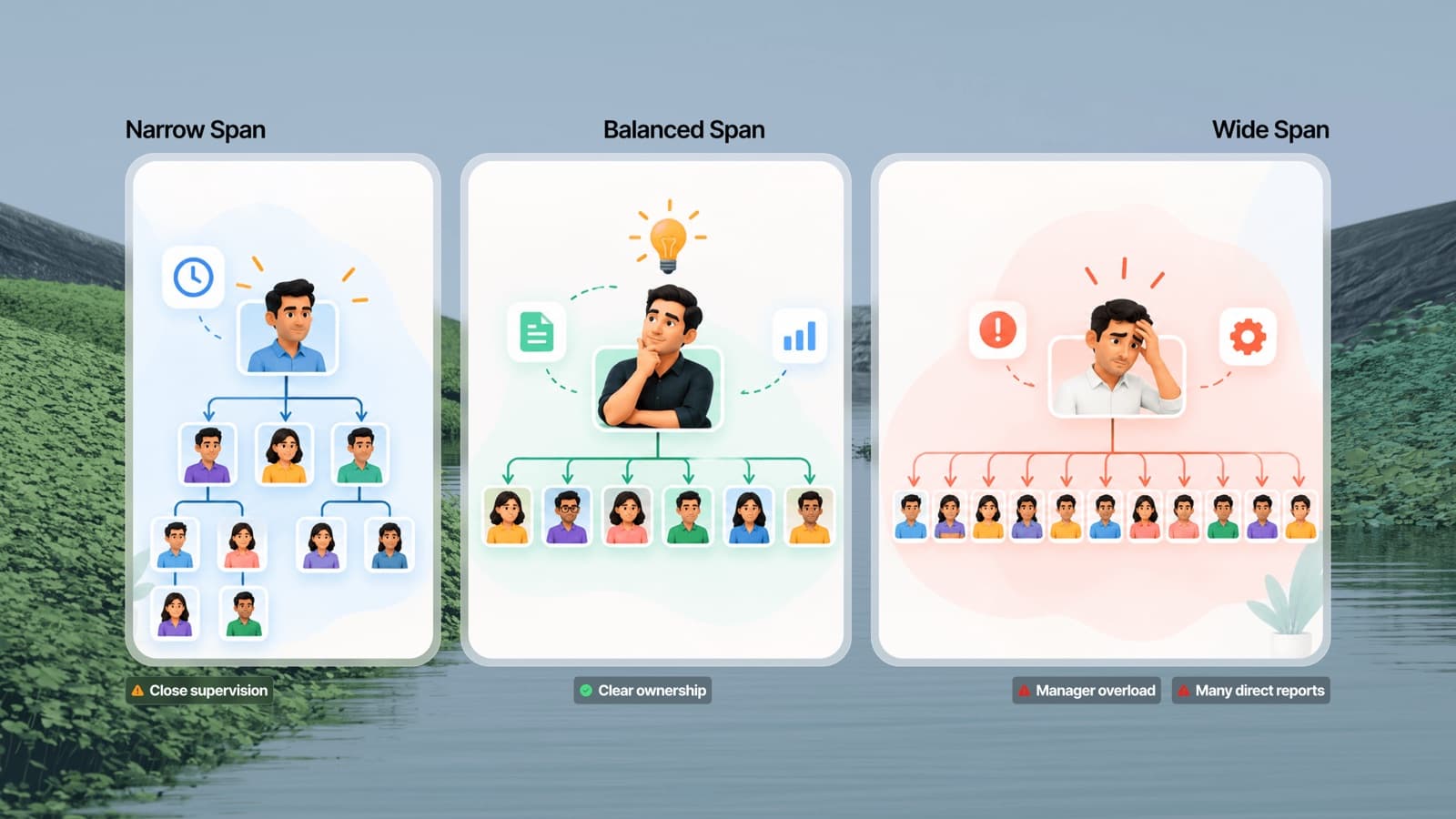


Few structural debates generate as much opinion as flat versus hierarchical. Flat structures promise speed and freedom; hierarchies promise clarity and control. In reality, most companies don't choose one forever - they move along a spectrum as they grow.
This article compares the two honestly and helps you decide where your company should sit today.
Definitions
Flat structure: few management layers between leadership and front-line employees. Managers have many direct reports, and employees are expected to make more decisions themselves.
Hierarchical (tall) structure: several management layers, each with a smaller number of direct reports. Authority and decisions follow a defined chain of command.
Side-by-side comparison
Advantages of a flat structure
- Speed. Fewer approvals means faster decisions and shorter feedback loops.
- Ownership. People closer to the work make more calls, which many find motivating.
- Lower cost. Fewer managers means lower salary cost and less internal reporting.
- Open communication. Leaders hear directly from the people doing the work.
Disadvantages of a flat structure
- Leader overload. When a founder has fifteen direct reports, one-on-ones, approvals and questions consume their week.
- Hidden hierarchy. Without formal structure, informal power often forms around long-tenured or loud employees - less fair and harder to see.
- Unclear decision rights. "Everyone can decide" often becomes "nobody is sure who decides".
- Limited growth paths. Ambitious employees may leave if there's no visible next step.
Advantages of a hierarchical structure
- Clarity. Everyone knows their manager, their scope and their escalation path.
- Consistency. Standards and processes are easier to enforce across large teams.
- Development. Team lead and manager roles create career steps and build leadership bench strength.
- Scalability. Adding people doesn't overload a single leader.
Disadvantages of a hierarchical structure
- Slower decisions as issues travel up and down layers.
- Distance from customers - leaders can lose touch with front-line reality.
- Too many approvals for things that don't need them.
- Departments that don't talk to each other because they report to different bosses.
Signs you've outgrown a flat structure
Flat structures often work well up to roughly 15-25 people. Watch for these warning signs:
- The founder or MD is holding things up. Work waits for their approval, and they can't take a week off.
- The same questions get asked repeatedly because nobody owns the answer.
- New hires take months to become productive, since knowledge lives in people's heads rather than documented processes.
- Conflicts go unresolved because no one has the authority to settle them.
- Good employees ask "what's next for me?" and there's no answer.
If three or more apply, it's time to add a layer - usually team leads or department heads.
Signs your hierarchy is too tall
On the other side, watch for:
- More than four or five layers in a company under a few hundred people.
- Managers with only one or two direct reports.
- Simple decisions requiring multiple sign-offs.
- Front-line teams learning about changes last.
Removing a layer, or giving team leads more decision rights, can restore speed without losing clarity.
The practical middle ground
Most growing companies do best with a lean hierarchy:
- A clear chain of command, so everyone has one manager.
- Wide but manageable spans of control - typically five to eight direct reports.
- Explicit decision rights, so people know which calls they can make without approval.
- Written SOPs, so people can work on their own without asking the one person who knows.
That combination keeps much of the speed of a flat structure while giving the clarity people need as the team grows.
Visualise before you restructure
Before changing your structure, draw both the current and the proposed version. Seeing them side by side makes it much easier to discuss with your team. You can build both with the free org chart maker - start from the startup template for a flatter shape or the small business template for a lean hierarchy.