
A startup's org chart is never finished. The structure that works brilliantly at eight people starts creaking at twenty and breaks at fifty. The goal isn't to design the perfect chart - it's to change it at the right moments.
Below is a practical guide to how startup structures typically evolve, stage by stage. Headcounts are rough guides, not rules; watch the warning signs more than the numbers.
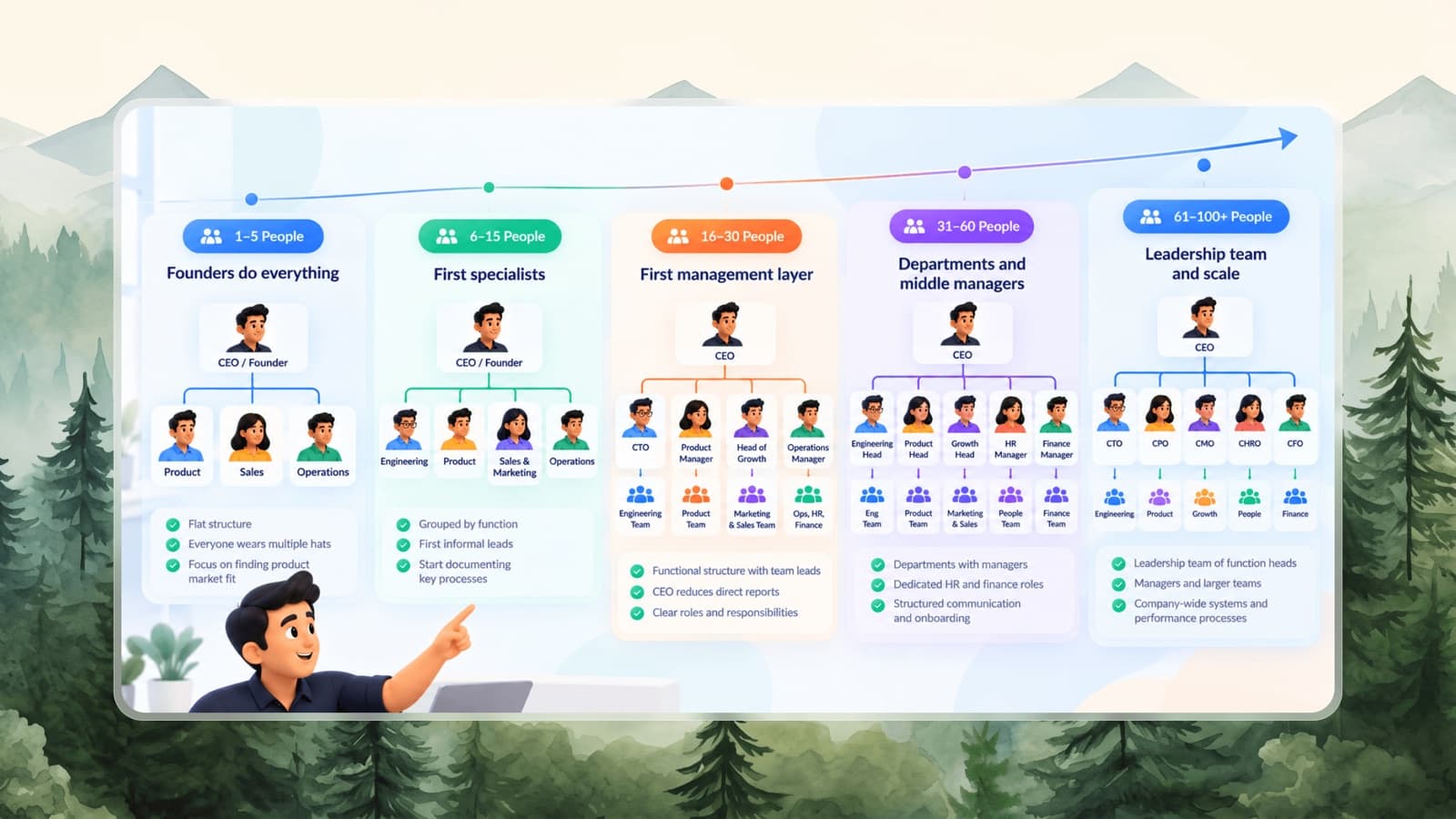
Stage 1: 1-5 people - founders do everything
Structure: flat. Founders plus a few generalists. Everyone reports to a founder.
What matters: splitting ownership between co-founders. Even at this size, write down who owns product, who owns sales, and who owns operations and money. Co-owning the same area is one of the most common sources of early conflict.
Chart: CEO and co-founders on one row, early hires beneath the founder they work with most.
Stage 2: 6-15 people - first specialists
Structure: still mostly flat, but grouped by function - a few engineers, one or two people in sales or marketing, someone handling operations.
What changes:
- The first hires in each function become informal leads.
- The founder starts spending most of their week on questions, approvals and one-on-ones.
- Things that "everyone just knew" start getting missed.
What to do now:
- Give each function one named owner, even if they're also an individual contributor.
- Start documenting the handful of processes that new hires keep asking about. See how to write an SOP.
- Draw the org chart for the first time and share it.
Stage 3: 16-30 people - the first management layer
Structure: functional with team leads. This is where many startups feel the most pain, because the flat structure has stopped working but nobody has been formally made a manager.
Warning signs you're here:
- The CEO has ten or more direct reports.
- Decisions wait days for founder input.
- New hires take months to ramp up.
- Two people are doing the same work - or nobody is.
What to do now:
- Appoint leads for your largest functions: usually engineering, sales/growth and operations.
- Reduce the CEO's direct reports to five to seven.
- Write clear roles and responsibilities for each lead: what they decide, what they escalate.
Example 25-person startup chart:
- CEO
- CTO → Engineering Manager → 6 engineers; QA lead → 1 QA engineer
- Product Manager → Designer
- Head of Growth → Marketing executive, content writer, 2 sales/BD executives
- Operations Manager → Customer success, HR & admin, finance executive
You can load this structure directly from the startup org chart template.
Stage 4: 31-60 people - departments and middle managers
Structure: departments with heads, and managers under them.
What changes:
- You need dedicated people functions: an HR manager and a recruiter become essential.
- Finance needs more than bookkeeping: budgets, forecasts and controls.
- Communication that happened naturally now needs structure - regular all-hands, written updates, team rituals.
What to do now:
- Promote or hire managers, and train them. First-time managers promoted from strong individual contributors often need support with delegation and feedback.
- Keep spans of control between five and eight. See span of control.
- Build a proper onboarding process - at this size you'll likely be hiring every month.
Stage 5: 61-100+ people - leadership team and scale
Structure: a leadership team of function heads (sometimes with titles like VP or Director), managers beneath them, and, for some startups, mixed-skill product teams or a divisional split by product or market.
What changes:
- The CEO manages the leadership team rather than functions.
- Company-wide systems become critical: documented SOPs, a central employee handbook, performance processes and clear decision rights.
- Culture becomes something you actively maintain rather than something that happens.
Common startup org chart mistakes
Titles too early. Giving your second marketing hire a "Head of Marketing" title makes it awkward when you later need a more experienced leader above them.
Promoting only the best individual contributor. The best engineer isn't automatically the best engineering manager. Consider the job, not the reward.
Hiring managers without teams. A manager with one direct report is usually a senior individual contributor with an expensive title.
Keeping the founder in every decision. If the chart shows leads but every decision still goes to the CEO, the structure exists only on paper.
Never updating the chart. Startups change monthly. An org chart from last year is fiction.
Plan the next stage before you reach it
The best time to design your next structure is a few months before you need it. Draw two versions: your chart today and your chart at the headcount you expect in 12 months. The gaps between them become your hiring plan.
Try it with the free org chart maker - start from the startup template, duplicate your thinking into a future version, and download both.